DARC: Advanced Contribution Workflow
|
Audience: SKaiNET maintainers and contributors taking on non-trivial work. Library consumers do not need this page. Routine fixes — a typo, an obvious bug, a CI tweak — also do not need DARC; the workflow exists for contributions where the open question "is this even the right thing to build?" is real. |
What DARC is
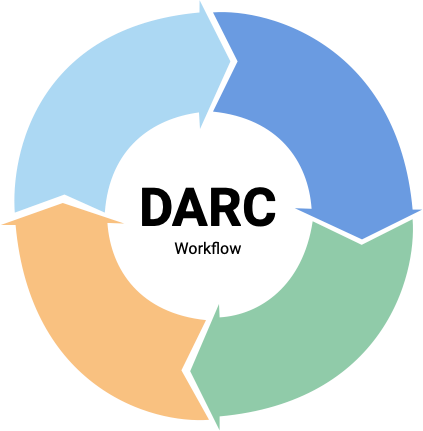
DARC is SKaiNET’s cyclical, document-driven workflow for advanced contributions: new operators, new modules, algorithmic changes, kernel strategies, format readers, anything where the design decisions matter as much as the code. This page is the authoritative definition — the four phases, when they apply, and how their outcomes get encoded in source.
DARC is cyclical and document-driven: the prose is the deliverable that survives the iteration, the code follows. Teams can enter at any phase and revisit earlier ones — a code review that surfaces a stale assumption sends the work back to Research, not forward to release.
The four phases
| Phase | Purpose |
|---|---|
D — Document |
Capture what and why in source-controlled prose before the code
exists. The artefact lives in |
A — Assess |
Validate the proposal against ground truth: reference implementations (PyTorch, JAX, NumPy), benchmarks, numerical-stability edge cases, cross-platform behaviour (JVM, Android, native). The output is a decision: approve, send back to Research, or back to Document if the problem statement turned out to be wrong. |
R — Research |
Survey existing solutions, dependencies, prior art, papers. Resolve the open questions raised in Document and Assess. Every claim that ends up in the final prose has a citation a reader can follow. |
C — Code |
Implement against the documented design with Gitflow, KtLint / Detekt, unit and integration tests, CI green. The Code phase produces running software, but the design it implements was settled in the prior phases — Code is execution, not invention. |
Repeat until the artefact converges. The minimum is one full cycle; in practice most non-trivial contributions go through the loop more than once.
When DARC applies
| Use DARC when | Skip DARC when |
|---|---|
Adding a new operator, layer, module, format reader, or backend. |
Fixing a typo or an obvious one-line bug. |
Changing public API surface or numerical behaviour of existing code. |
Reformatting, renaming a variable, removing dead code. |
Introducing a new dependency, build tool, or CI workflow. |
Bumping a dependency version with no behavioural change. |
Algorithmic work where the design decisions are not self-evident from the diff (kernel strategies, quantisation schemes, attention variants). |
Adding a missing test for already-shipped behaviour. |
The signal for "DARC applies" is whether a reasonable maintainer six months from now would want to know why the change is shaped the way it is. If yes, the work belongs in DARC; if the diff speaks for itself, it doesn’t.
DARC and SKEEP
SKaiNET has a second process, SKEEP (SKaiNET Evolution and Enhancement Process), and the two trigger lists overlap enough to confuse. The distinction:
| DARC | SKEEP | |
|---|---|---|
Unit of work |
One feature: an operator, layer, module, metric, format reader, backend, kernel strategy. |
One architectural decision: public API shape, DSL syntax or semantics, tensor dtype/shape/storage/execution behaviour, compiler/runtime integration, compatibility policy. |
Artefact |
Feature issue + lane sub-issues; for operators, a doc partial and
|
A numbered proposal in |
Lifecycle |
✖ → ⚠ → ✅ ( |
|
Sign-off |
A reviewer who is not the implementer. |
A maintainer, by moving the status field. |
Rule of thumb: if the change trips a SKEEP trigger, write the SKEEP first and let the DARC feature issue’s Document section link to it. DARC decides whether and how to build a thing; SKEEP decides the shape of the codebase the thing lands in. When a DARC feature runs into a SKEEP-sized question mid-way — the F1Score worked example does, in its ground-truth lane — split the question out into its own SKEEP rather than settling it inside a sub-issue. The full decision list is in Getting started → DARC or SKEEP?.
Decomposing a DARC feature into lanes
The four phases say what has to happen; they do not say who can do it. A DARC feature issue is therefore split into lane sub-issues — numerics research, Kotlin core, per-platform verification, ground-truth wiring, docs, review — each labelled with the single skill it needs and an honest size, so the backlog is filterable by "things I can do" across all features. The lanes, labels, and templates are defined in Issue taxonomy; the parent issue’s Document section states which lanes apply to this feature.
Specialisation: operator documentation
Operator documentation is the largest single application of DARC in the project today — a four-figure number of method-level pages, each fusing auto-derived API facts with human-written math, intuition, examples, and references. Because the surface is huge and uneven, operator docs are the only DARC artefact that carries a machine-checkable validation flag.
Mapping DARC to operator-doc work
| Phase | What it means for an operator |
|---|---|
D — Document |
Write or refresh the partial at
|
A — Assess |
Validate the prose against ground truth: a reference implementation (PyTorch / JAX / NumPy), known numerical-stability edge cases, and SKaiNET’s runtime. Run every documented example end-to-end; shapes, dtypes, and numerical answers must match. |
R — Research |
Every non-trivial claim has a citation. Reviewer clicks every link and confirms it still resolves and supports the claim. Dead or drifted citations are a hard fail. |
C — Code |
Confirm the implementation matches the documented contract.
|
The @DarcValidated annotation
When an operator function has passed DARC end-to-end, the reviewer (not the original author) annotates the function in source:
import sk.ainet.lang.ops.DarcValidated

public interface TensorOps {
    @DarcValidated(by = "First Last <user@example.com>", on = "2026-05-24")
    public fun <T : DType, V> matmul(a: Tensor<T, V>, b: Tensor<T, V>): Tensor<T, V>
}
The KSP processor (OperatorDocProcessor) picks up the annotation
and threads it through operators.json into the generated reference
page and the coverage matrix:
| Signal | Meaning |
|---|---|
|
|
|
A partial exists at |
|
No partial on disk and no annotation. The reader sees only the auto-derived signature, parameters, return type, and backend status. |
The same three states appear as ✅ / ⚠ / ✖ in the Validated column
of the operator coverage matrix.
Criteria for setting @DarcValidated
All of the following must be true before the annotation goes in:
-
The reviewer is not the original author. Two pairs of eyes on the prose is the entire point.
-
D — Document. The partial has non-empty
math,intuition,examples, andreferencestags. None are placeholders. -
A — Assess. Every example in the partial has been executed against the SKaiNET implementation and produces the documented result. Boundary cases for any numerical-stability claims have been spot-checked.
-
R — Research. Every citation resolves and supports the specific claim it backs. Broken or drifted links are a hard fail.
-
C — Code.
statusByBackendreflects reality.
Set referencesChecked = false only as a deliberate signal — e.g. a
citation behind a paywall the reviewer could not open. The badge
still renders as validated; the flag is there so a future reviewer
knows what was skipped.
Updating an already-validated operator
Editing the prose of a @DarcValidated function invalidates the
validation. The contributor making the change must:
-
Remove the
@DarcValidatedannotation in the same change that edits the partial. The page falls back to the ⚠ badge until a fresh review. -
Open a new review request once the change is in.
This is the price of keeping the validation signal in code: any prose change has to flow through a fresh review before the badge comes back.
Where DARC lives in the repo
| Location | Role |
|---|---|
This page ( |
Authoritative definition of the workflow, when it applies, and how its outcomes are encoded. |
|
Issue template for new DARC proposals. Section headers match the four phases: Document / Assess / Research / Code. |
|
Issue template for one lane of a DARC feature, opened as a native sub-issue of the parent. Labelled by skill, size, and phase — see Issue taxonomy. |
|
The label taxonomy the lane sub-issues use, and the script that applies it. |
One feature taken through all four phases, its lane breakdown, and the point where it hands a question over to SKEEP. |
|
|
The annotation that records a passed DARC review on an operator
function. |
|
Reads |
|
Renders the badge above each function’s signature and the Validated column in the coverage matrix. |